Sign up for the One Day In July newsletter to receive meaningful insights from the One Day In July Investment Desk. Once a month, direct to your inbox.
The foundation of modern investing originated from an unexpected source: Scottish botanist Robert Brown, who observed in 1827 that tiny particles suspended in liquid move in a continuous, random jitter—a phenomenon later named Brownian motion.1 At the turn of the 20th century, French mathematician Louis Bachelier applied this insight to financial markets, proposing that stock price movements mirror this same random walk around their true intrinsic value. Because price changes respond to unpredictable news, Bachelier famously theorized that “the mathematical expectation of the speculator is zero”.2
Decades later, Nobel laureates Paul Samuelson and Eugene Fama formalized these ideas into the Efficient Market Hypothesis (EMH).3 Fama categorized efficiency into three distinct forms:
At its core, every stock price is a real-time tally of all investors’ expectations. Market efficiency does not mean prices are always perfectly "correct" or immune to hindsight mistakes. Rather, it means that because knowable facts are already reflected in the price, the next directional move is unpredictable. Consequently, paying high management fees to search for "mispriced" securities is often a costly effort in a game stacked against the picker.
A persistent myth in finance is that sharp market swings prove markets are irrational or broken. When unexpected news hits—such as sudden tariff announcements, geopolitical shifts, or oil price fluctuations—prices reprice rapidly.
Far from proving inefficiency, volatile movement demonstrates market efficiency in action. A functioning market should reprice immediately when surprising news arrives. If markets adjusted slowly, professional traders could easily exploit the lag for risk-free profits.
Michael Jensen’s landmark 1968 study of mutual funds confirmed this reality. After accounting for expenses and trading costs, professional fund managers consistently failed to beat a simple buy-and-hold strategy.4 They generated no net "alpha" (excess returns above risk-adjusted market performance).
Market efficiency is not static, and dynamics evolve over time. Practitioners like Cliff Asness, founder of AQR Capital Management, note that retail trading trends and headline noise can create occasional pockets of short-term inefficiency.5 Even so, the fundamental takeaway holds: after accounting for trading costs, taxes, and management fees, active stock picking consistently underperforms the market.6
Connecting efficiency to portfolio management requires understanding Harry Markowitz’s Modern Portfolio Theory and Burton Malkiel’s principles from “A Random Walk Down Wall Street”.7 Grounded in market efficiency, financial science divides risk into two categories:
Holding a concentrated portfolio of a few individual stocks exposes an investor to substantial company-specific risk without a higher expected return. Conversely, holding a broad index fund containing thousands of companies minimizes uncompensated risk, helping align the portfolio directly with broad economic growth.
To see market efficiency at work, consider two everyday scenarios where investors frequently misunderstand how prices move:
When a company reports record profits, investors are often surprised when its stock drops the same morning. Why? Because an efficient market already priced in high expectations based on public data. If profits rise 15% but the market expected 20%, the stock falls because the results fell short of what was already built into the price. You are unlikely to profit from headlines because the market adjusts instantaneously.8,9
| Company & Earnings Date | The "Good News" (Actual Results) |
The Priced-In Expectations | The Market's Reaction (Stock Drop) |
Why It Fell (The "Hidden" Catch) |
|---|---|---|---|---|
| Paychex (PAYX) September 23, 2026 |
- Revenue: $1.63B (5.8% YoY) - Adj. EPS: $1.34 (vs. $1.32 expected) |
Record full year profits were already priced in, leaving little margin for error. | Dropped ~9% following their Q4 earnings release. | The shortfall: Earnings beat expectations but concerns around future growth and the company’s forward outlook caused a rapid drop in price. |
| NVIDIA (NVDA) August 27, 2026 |
- Revenue: $96.2B (+106% YoY) - Adj. EPS: $2.22 (vs. $2.10 expected) |
Wall Street already expected stellar results, so beating estimates was merely the baseline. | Dropped 1.8% in immediate after-hours trading. | The shortfall: Despite doubling revenue, management guided that future gross margins would temporarily dip to 71%–72% due to rising memory chip costs. |
Political rhetoric and election anxiety frequently tempt investors to exit to cash during U.S. midterm cycles. Pre-election noise subdues performance (S&P 500 averages -0.32% in the six months prior). But once election results resolve legislative ambiguity, the market rapidly reprices asset values (+13.36% average gain in the six months post-election across 20 cycles from 1946–2022).10 Market timers exiting early frequently miss the rebound because the efficient market reprices risk far faster than individuals can react.
| Period Relative to Midterm Election | Average S&P 500 Return | Median Return | Positive Return Frequency |
|---|---|---|---|
| 6 Months Before Midterm | -0.32% | 2.00% | 11 of 20 cycles (55%) |
| 6 Months After Midterm | 13.36% | 14.48% | 19 of 20 cycles (95%) |
Our core investment philosophy directly translates these academic foundations into disciplined client portfolios. Because liquid public markets process new information rapidly, attempting to outperform through stock selection or tactical market timing imposes uncompensated risk with limited upside.
Understanding market efficiency fundamentally changes how investors could view headlines, political cycles, and short-term market swings. As Burton Malkiel, Eugene Fama, and decades of financial research have demonstrated, short-term price movements reflect the rapid processing of unexpected news rather than market failure.
Rather than treating volatility as a trigger to alter long-term strategy or pursue uncompensated risks through stock-picking, disciplined investors let market efficiency work in their favor. By maintaining low-cost indexed asset allocations, focusing on underlying business earnings, and remaining disciplined through every cycle, clients can position themselves for long-term financial success.
One Day In July LLC is an SEC-registered investment advisor. Registration does not imply a certain level of skill or training. One Day In July LLC does not guarantee actual returns or losses. The content of this newsletter is for educational purposes only and is not investment advice. Individual circumstances may vary.
Sources:
[1] EBSCO. Brownian Motion. https://www.ebsco.com/research-starters/history/brownian-motion/
[2] History of Data Science (June 2021). Louis Bachelier. https://www.historyofdatascience.com/louis-bachelier-an-underappreciated-revolutionary/
[3] EBSCO. Efficient-Market Hypothesis (EMH). https://www.ebsco.com/research-starters/social-sciences-and-humanities/efficient-market-hypothesis-emh/
[4] The Journal of Finance. Performance of Mutual Funds (May 1968). https://onlinelibrary.wiley.com/doi/full/10.1111/j.1540-6261.1968.tb00815.x
[5] AQR (November 2024). Journal of Portfolio Management. https://www.aqr.com/-/media/AQR/Documents/Perspectives/TheLessEfficientMarketHypothesis.pdf?sc_lang=en&hash=7630BDE83CDFC603F55633DDCCDA8560
[6] SPIVA (September 2026). https://www.spglobal.com/spdji/en/spiva/article/spiva-us/
[7] One Day In July (December 2025). Active vs. Passive Investment Management: A “Random Walk Down Wall Street.”. https://www.onedayinjuly.com/active-vs-passive-investment-management
[8] Paychex (September 2026). Earnings Release FY27 Q2. https://finance.yahoo.com/markets/stocks/articles/paychex-payx-beat-earnings-then-124531122.html
[9] NVIDIA (August 2026). Earnings Release FY27 Q2. https://finance.yahoo.com/markets/stocks/article/nvidia-tops-q2-expectations-offers-strong-q3-outlook-revenue-96-billion-112502189.html
[10] MacroTrends “S&P 500, Daily Since 1927” and S&P Global 2025 S&P 500 Performance Data. https://media.onedayinjuly.com/media/pdf/ODIJ_AllTime_Highs.pdf
Geopolitics and soaring refining margins are dominating the news. Your long-term, passive portfolio is already designed to handle the noise—no active trading required.
Every few years, financial markets are hit with an uncomfortable reminder: energy sits at the center of the global economy.
Whether driven by conflict in the Middle East, shipping bottlenecks in the Strait of Hormuz, or refinery outages, oil disruptions ripple through virtually every sector. Petroleum powers over 90% of global transportation and serves as a vital input for agriculture, aviation, plastics, and pharmaceuticals.1 When energy prices surge, corporate costs rise and central banks rethink rate cuts.
When these headlines break, investors inevitably ask: "Should I be changing my portfolio?"
The short answer is no.
Major energy shocks—from the 1973 embargo to the 2022 war in Ukraine and today's war in Iran—frequently drive double-digit commodity spikes and push refining margins to record highs.2 The temptation to react is understandable, but translating headline drama into trading decisions introduces unnecessary risk.
Behavioral finance shows that we feel the pain of financial losses far more intensely than the joy of equivalent gains.3 During periods of geopolitical uncertainty, this loss aversion creates a common panic trap.
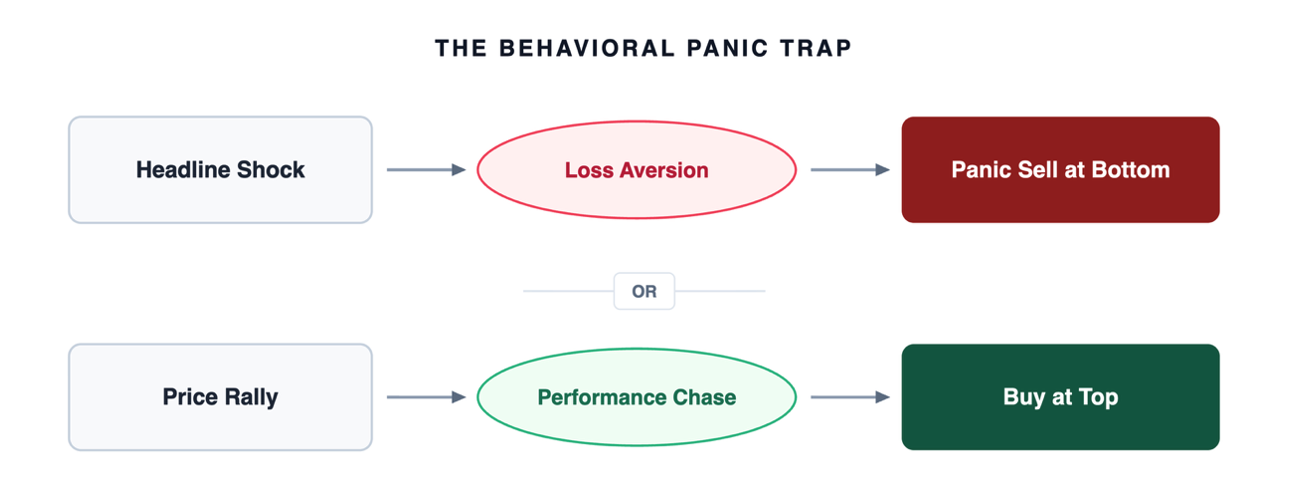
Trying to trade energy shocks requires navigating a multi-layered global system rather than a single ticker symbol.
Consider the volatility of 2026:
In the months leading up to these events, oil markets operated in a calm, baseline environment with West Texas Intermediate (WTI) crude trading in the low $60s.4 As headlines broke throughout 2026, market behavior swung sharply as prices spiked toward $110 following the February strikes, collapsed back toward $70 during the April ceasefire relief, consolidated through June's diplomatic talks, and surged back to $90 after July's renewed strikes voided the MOU.5
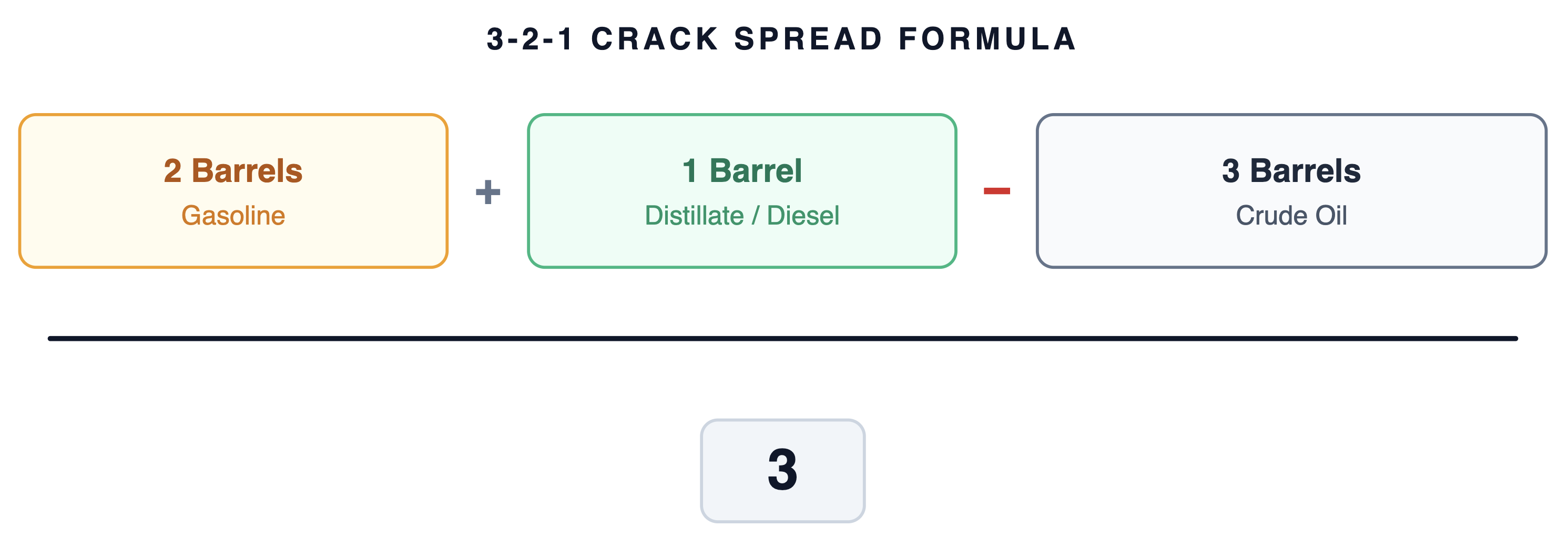
Simultaneously, on July 16, 2026, the US 3-2-1 crack spread—the margin refiners earn converting crude into gasoline and diesel—also hit a record high near $70 per barrel.6 While raw crude prices swung unpredictably, consumer fuel prices stayed elevated due to refining bottlenecks and shipping constraints.
The crack spread illustrates the standard industry formula used to calculate a refiner's gross profit margin per barrel. It takes the combined market value of two barrels of gasoline and one barrel of distillate/diesel, subtracts the cost of three barrels of unrefined crude oil, and divides the result by three to determine the average margin earned from processing raw crude into usable fuel. The formula uses this specific 3-2-1 ratio because standard petroleum refineries typically yield roughly two barrels of gasoline and one barrel of distillate fuel (such as diesel or jet fuel) for every three barrels of crude oil they process.
To successfully time an energy shock, an investor would need to correctly predict crude futures, refining margins, shipping friction, and market psychology all at once. Beyond commodity volatility, the 2026 disruption created broad economic pressures:
The critical point here is that you do not need to guess where oil prices, crack spreads, or geopolitics will go next. A disciplined, passively diversified portfolio should hold the broader market, absorbing the shocks and capturing economic realignment without falling into the headline panic trap.
The 2026 Middle East conflict highlights why timing localized geopolitical shocks is an impossible task for investors.
At the heart of the disruption is the Strait of Hormuz, a maritime corridor that handled over 20 million barrels per day in 2025, which is roughly 20% of global petroleum liquids alongside liquified natural gas (LNG) volumes.8 Major Middle Eastern producers depend on this single passage. Because oil cannot be rerouted overnight due to finite pipeline capacities and limited strategic reserves, even the mere threat of friction causes wild price swings based on fear rather than actual physical shortages.
Focusing solely on crude futures misses the broader structural friction across the supply chain. Tightened global refinery capacity and war damage severely reduced processing capabilities in the region, while surging war-risk insurance premiums for Persian Gulf tankers spiked the landed cost of crude regardless of paper futures prices.9 Compounding the issue, finished fuel stocks were already sitting near multi-decade lows before the conflict even began.
Ultimately, energy markets represent a complex, interconnected web of extraction, shipping, refining, and insurance. Broad diversification remains an effective shield against these multi-layered dynamics. While active traders may repeatedly respond to the volatility of headlines, long-term, passive portfolios simply absorb the noise.
Over the last 50+ years, major oil price shocks have repeatedly driven economic volatility. Yet markets, consumers, and policy have consistently adapted and recovered.
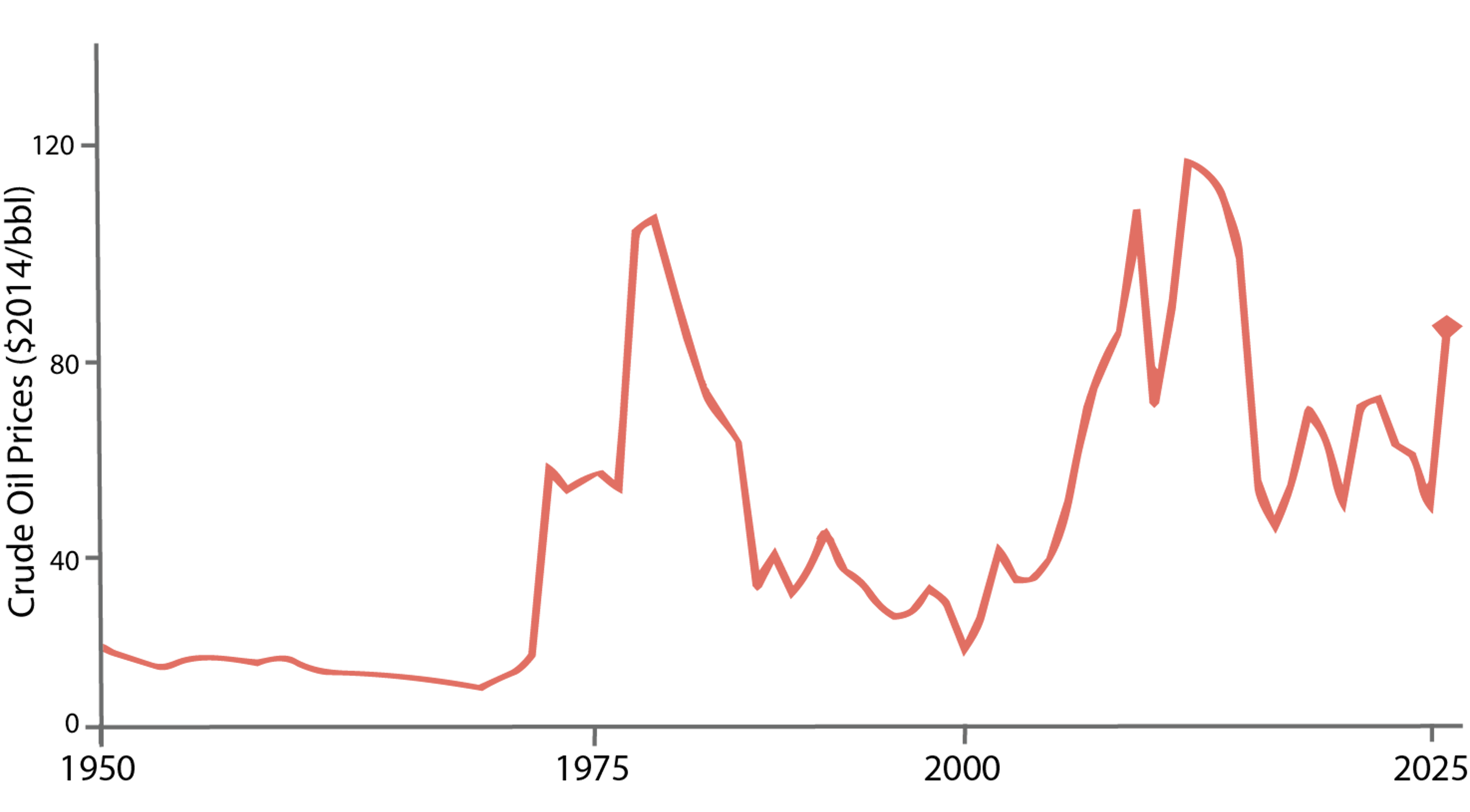
Source: https://media.onedayinjuly.com/media/images/Spring_2026_Quarterly_Booklet-Web.pdf
1973 OPEC Oil Embargo10
1978–1979 Iranian Revolution12
1990 Gulf War13
Mid-2010s Supply Glut14
2020 Pandemic Collapse15
2022 Russia-Ukraine War16
The important historical insight remains unchanged. Whether a shock is supply- or demand-driven, the end result is consistent: economies adapt, new equilibriums form, and disciplined, long-term investors historically have been rewarded for staying the course.
The Iran conflict has generated a constant stream of geopolitical catalysts, with rounds of ceasefires and escalations shaking markets for months. Attempting to trade each headline requires getting the exposure, direction, and timing right all at once—a near-impossible task. Geopolitical events are inherently unpredictable, which is precisely why markets react so sharply to new developments.
Passive, index-based investing does not assume global crises can be predicted. No investor can consistently forecast geopolitical moves, inflation stickiness, or central bank decisions. Instead of betting on unknowable outcomes, broad diversification embraces uncertainty as a permanent feature of the market.
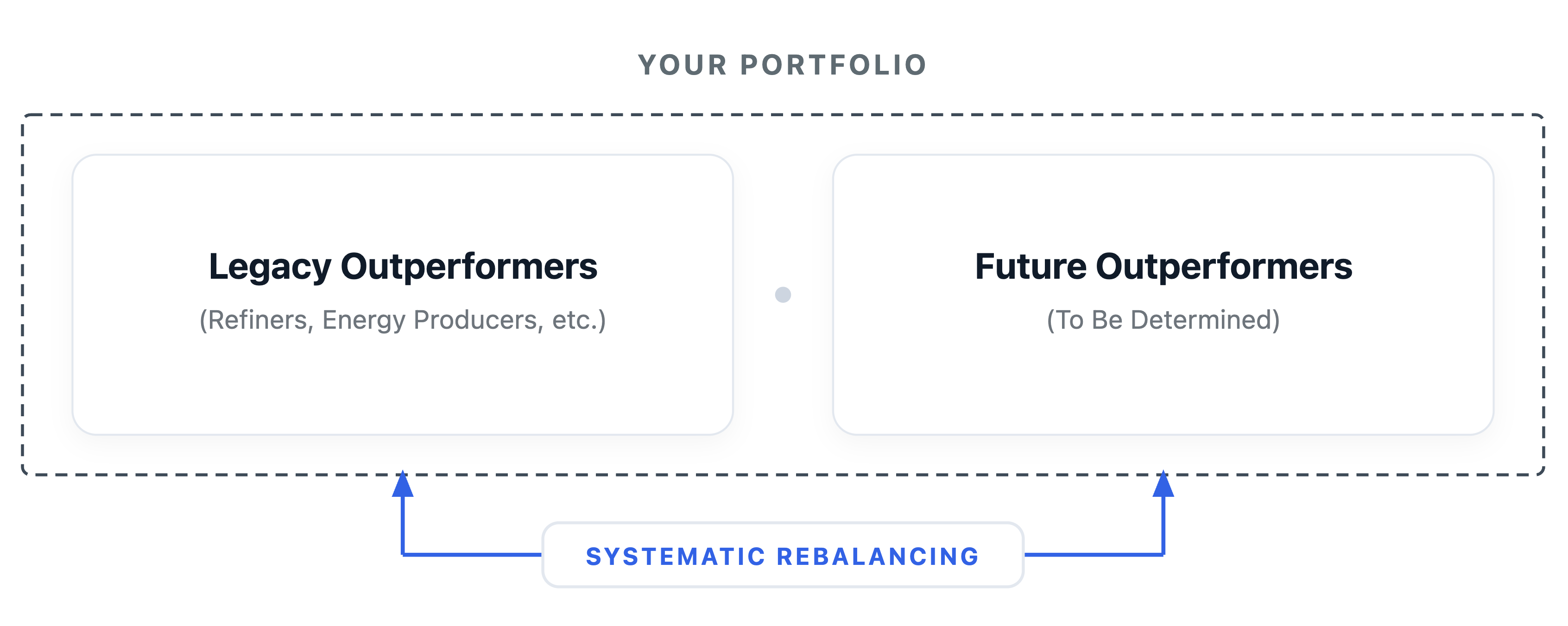
Broad-based equity indexes eliminate the need to pick single winners or predict complex market shifts. Furthermore, market-cap-weighted index funds automatically adjust as sector performances diverge. As outperforming sectors gain weight, index investors naturally capture that growth without executing a single discretionary trade.
The ultimate winners of any market disruption are rarely obvious at the start. Following the 1970s oil embargos, for instance, foreign automakers producing fuel-efficient cars emerged as major beneficiaries—a shift few predicted when crude prices first spiked. Those who benefit over the long-term from the 2026 oil shock will similarly become clear only in hindsight. While every crisis feels unprecedented, history shows that global markets adapt, evolve, and grow over time. Remaining passively invested helps to ensure you participate in that recovery without taking on unnecessary speculative risk.
Record crack spreads and Strait of Hormuz headlines make for compelling news, but these exciting daily occurrences should not dictate your financial plan. You don't need a military, diplomatic, or refining strategy to build long-term wealth.
By tuning out short-term noise and letting systematic rebalancing do the heavy lifting, your portfolio remains structurally designed to endure whatever headline comes next. Staying passive isn't just about ignoring the noise—it's an effective strategy for navigating oil shocks and preserving long-term growth.
One Day In July LLC is an SEC-registered investment advisor. Registration does not imply a certain level of skill or training. One Day In July LLC does not guarantee actual returns or losses. The content of this newsletter is for educational purposes only and is not investment advice. Individual circumstances may vary.
Sources:
[1] International Energy Agency (2025). Transport. https://www.iea.org/reports/energy-efficiency-2025/transport
[2] World Economic Forum (April 17, 2026). How Oil Prices Have Reacted to World Events Since the 1980s. https://www.weforum.org/stories/energy-transition/the-big-chart-price-of-oil-through-history/
[3] Kahneman & Tversky (1977). Prospect Theory. An Analysis of Decision Making Under Risk. https://web.mit.edu/curhan/www/docs/Articles/15341_Readings/Behavioral_Decision_Theory/Kahneman_Tversky_1979_Prospect_theory.pdf
[4] Federal Reserve Bank of Dallas (June 5, 2026). https://www.dallasfed.org/research/swe/2026/swe2614
[5] Bloomberg (July 16, 2026). Turning Oil to Fuel Has Never Been More Profitable as Refining Margins Surge. https://www.bloomberg.com/news/articles/2026-07-16/turning-oil-to-fuel-has-never-been-more-profitable-as-refining-margins-surge
[6] Reuters (July 16, 2026). Refiner Margins Hit New Records. https://www.reuters.com/business/energy/us-refiner-margins-hit-new-records-fuel-shortage-concerns-grow-2026-07-16/
[7] CNBC (June 10, 2026). Consumer Prices Rose 4.2% Annually. https://www.cnbc.com/2026/06/10/cpi-inflation-report-may-2026.html
[8] International Energy Agency (February 2026). Strait of Hormuz Factsheet. https://www.iea.org/about/oil-security-and-emergency-response/strait-of-hormuz
[9] Bloomberg (August 1, 2026). Fuel Prices to Endure as War Knocks Refining. https://www.bloomberg.com/news/articles/2026-08-01/exxon-chevron-warn-fuel-prices-to-endure-as-war-knocks-refining
[10] U.S. Department of State. Office of the Historian, Oil Embargo 1973-1974. https://history.state.gov/milestones/1969-1976/oil-embargo
[11] Congressional Research Service. Oil Market Disruptions and Historical Precedents. https://www.congress.gov/crs-product/R45281
[12] Federal Reserve History. Oil Shock of 1978-79. https://www.federalreservehistory.org/essays/oil-shock-of-1978-79
[13] Hamilton (2011). University of California, San Diego. Historical Oil Shocks. https://econweb.ucsd.edu/~jhamilton/oil_history.pdf
[14] International Monetary Fund (2016). U.S. Shale Revolution and Its Spillover Effects on the Global Economy. https://www.elibrary.imf.org/view/journals/026/2016/004/article-A002-en.xml
[15] Commodities Futures Trading Commission (November 23, 2020). Crude Contract Trading. https://www.cftc.gov/PressRoom/PressReleases/8315-20
[16] Federal Reserve Bank of Dallas (March 22, 2022). The Russian Oil Supply Shock of 2022. https://www.dallasfed.org/research/economics/2022/0322
[17] World Bank Group (April 2026). The Effects of Geopolitical Oil Price Shocks. https://www.lse.ac.uk/CFM/assets/pdf/CFM-Discussion-Papers-2026/CFMDP2026-08-Paper.pdf
As a fiduciary firm dedicated to your long-term financial clarity, we continually monitor the structural forces shaping the markets. This month, we are taking a look at the Initial Public Offering (IPO) ecosystem, and how it is impacting index fund investing.
Over the last several decades, an unprecedented surge in private venture capital has fundamentally shifted capital formation, changing both how long companies stay private and how they are valued when they finally list on public exchanges. Mega IPOs like SpaceX have prompted highly visible shifts among index providers. Major benchmarks are rewriting their rules to capture newly public companies faster than ever before—a structural evolution that carries important implications for your passive portfolio.
An IPO is when a private company sells new shares to the public for the first time, typically on exchanges like Nasdaq or the New York Stock Exchange, with investment banks helping value, file, and market the deal. The proceeds usually fund expansion, R&D, or debt reduction, and because the company is issuing new shares and raising capital directly, an IPO is a primary market transaction, unlike secondary market trading between investors.
One major development in the modern IPO market is the age at which companies go public. In 2000, the median age of a company listing on a U.S. exchange was just 6 years.1 By 2025, that age doubled to 12.
A primary driver of the delay comes from the rise of venture capital.2 The structural landscape of capital formation fundamentally shifted with the National Securities Markets Improvement Act (NSMIA) of 1996.3 By preempting state-level regulations and expanding exemptions for private investment funds, this deregulation allowed private equity and venture capital to pool massive amounts of capital from qualified purchasers. By the early 2000s, venture capital firms were raising annual sums in the low tens of billions. Since 2020, the industry has raised over $1 trillion, providing capital to thousands of private companies across the U.S. Backed by abundant private capital and eager to avoid the regulatory burdens of public markets, companies are choosing to stay private for longer.
This delay has important tradeoffs. On one hand, it can worsen wealth inequality by reserving the biggest early gains for wealthy investors and institutions, while reducing transparency by keeping fast-growing companies outside public disclosure rules. On the other hand, it can also protect retail investors from the high failure risk of early-stage companies, since private capital is better suited to absorb those losses. In that sense, private markets function as a shock absorber, allowing companies to mature before entering the public markets.
IPOs are exciting. They are major milestones for companies and command a market buzz as the new kid on the proverbial block. Major listings also tend to be oversubscribed, meaning investors request more shares than are available. This can lead to jumps in the price of a newly issued security. In fact, from 2012 to 2024, the average first-day trading increase for an IPO was 25.4%.4
However, strong initial jumps can dampen future returns. During the same 13-year period, the average IPO realized a cumulative return of just 14.1% over the three years following its public market inclusion.5 Even worse, when you adjust for the size of the IPO, meaning larger IPOs hold a higher weight, the returns fall to a cumulative -18.7%. This points to the largest and most blockbuster IPO underperforming smaller, lesser-known companies.
Part of the reason shares trade down in the months and years following the initial offering is that insiders are selling. Often company insiders are barred from selling shares for a prespecified amount of time after an IPO. Once these restrictions are lifted, many begin to sell part or all their holdings as their shares are finally salable.
Historically, major indexes required companies to trade publicly for a period and meet other strict criteria before being included into the index. However, a handful of very large, well-known private companies have prompted index providers to revisit these rules, allowing a few mega IPOs in 2026 to be included sooner.6
Some index providers argue that if a newly listed company is already a multi-billion-dollar enterprise with strong investor demand, it must be included immediately to ensure the index accurately reflects the broader market. While this rationale has merit, shortening these “seasoning” periods or relaxing inclusion rules introduces risks. It forces index funds—and, by extension, many Americans’ retirement savings—to absorb the intense early volatility often triggered by initial investment bank misvaluations or the expiration of insider lockup periods.
Throughout its history, the Fed has continuously navigated tension between autonomy and accountability. Legislative changes such as the Banking Act of 1935 strengthened its independence, while periods of war, inflation, and financial stress have tested its limits.6
This trend fundamentally redefines what it means to own “the market" via a passive portfolio. The danger lies in the precedent these rule changes establish: companies with inflated private valuations or minimal public ownership (referred to as a free float) can now secure accelerated entry into major indexes. If these aggressive valuations fail to hold post-listing, everyday investors “buying the market”—investors who assume they are buying a diversified, relatively stable basket of equities—will bear the brunt of the downside.
Here is how major index providers are shifting their inclusion methodologies:
For long-term investors, we believe index investing remains one of the most reliable ways to build wealth because of its self-correcting nature. If a highly valued mega IPO enters an index and its valuation later weakens, a market-cap-weighted fund will naturally reduce exposure as the company’s share price and market capitalization fall. Broad-market indexing also helps reduce the concentration risk of any single blockbuster listing by spreading exposure across hundreds or thousands of companies, so the impact of one stock’s underperformance is diluted.
As highlighted earlier, because the average size-adjusted IPO has faced a cumulative three-year return of -18.7% over the last decade or so, trying to pick winning individual stocks or chase opening-day hype remains statistically disadvantageous. Passive indexing bypasses this stock-picking risk entirely while maintaining excellent cost and tax efficiency. It keeps transaction fees low so that more of your money remains invested to benefit from the power of long-term compounding.
To put this diversification into perspective, the mathematical structure of a broad-based index inherently minimizes single-stock exposure. For example, even if a highly anticipated mega IPO debuts at a $100 billion valuation, it would initially account for less than 0.25% of a $67+ trillion broad-market benchmark like the S&P 500. For an individual investor holding a diversified portfolio split between equities and fixed income, that specific company's direct impact shrinks to a mere fraction of a percent. This structural insulation helps ensure that even a severe post-IPO devaluation of a single blockbuster company remains a minor ripple rather than a catastrophic event for a long-term retirement portfolio.
The IPO landscape is undeniably evolving, driven by an unprecedented influx of private venture capital that has fundamentally altered company dynamics. This private funding, combined with accelerated inclusion timelines from major index providers, means that modern passive portfolios will begin absorbing early public volatility sooner than they did in the past. We saw this structural shift manifest in real time following the historic June 2026 IPO of SpaceX, which raised approximately $75 billion and commanded a market capitalization of $1.77 trillion.12 Rather than waiting out traditional multi-month seasoning periods, many index funds—and by extension, everyday retirement savings—are now being positioned to navigate the immediate aftermath of mega IPOs.
This response highlights a stark rift in indexing philosophies. While FTSE Russell, Nasdaq, and Morningstar favor immediate market representation by fast-tracking new giants, S&P Dow Jones prioritizes index stability, using strict seasoning and profitability guardrails to insulate investors from early volatility.13 Depending on which benchmark your fund tracks, your portfolio is either actively absorbing this high-stakes early trading or waiting for these companies to mature.14
At One Day In July, we look past short-term market buzz to focus entirely on what serves your financial future over the long haul. While accelerated index timelines introduce a bit more early volatility, these evolving market lifecycles are simply structural shifts to monitor—not a reason to abandon a time-tested strategy. Broad-market index investing remains an efficient, straightforward, low-cost, and historically sound path to long-term financial security. By staying disciplined and maintaining broad diversification, we strive to navigate these marketplace changes smoothly and keep your wealth growing steadily.
One Day In July LLC is an SEC-registered investment advisor. Registration does not imply a certain level of skill or training. One Day In July LLC does not guarantee actual returns or losses. The content of this newsletter is for educational purposes only and is not investment advice. Individual circumstances may vary.
Sources:
[1] University of Florida, Median Age of IPOs Through (December 2025). https://site.warrington.ufl.edu/ritter/files/IPOs-Age-of-Companies-Going-Public.pdf
[2] Fortune, Mega IPOs May Wait to Join S&P 500 (June 2026). https://fortune.com/2026/06/06/spacex-openai-anthropic-mega-ipo-sp500-inclusion-nasdaq-russell/
[3] Yale Law School, Deregulation of Private Equity Markets and Decline in IPOs (September 2019). https://law.yale.edu/sites/default/files/area/workshop/leo/leo19-ewens.pdf
[4] University of Florida, Underpricing IPOs (May 2026). https://site.warrington.ufl.edu/ritter/files/IPOs-Underpricing.pdf
[5] University of Florida, IPO Statistics (June 2026). https://site.warrington.ufl.edu/ritter/files/IPO-Statistics.pdf
[6] Fortune, Mega IPOs May Wait to Join S&P 500 (June 2026). https://fortune.com/2026/06/06/spacex-openai-anthropic-mega-ipo-sp500-inclusion-nasdaq-russell/
[7] ETF Stream, FTSE Russel to Fast-Track Mega IPO Entry (May 2026). https://www.etfstream.com/articles/ftse-russell-indexes-to-fast-track-entry-of-us-mega-ipos
[8] Reuters, New Nasdaq Rules (March 2026). https://www.reuters.com/business/new-nasdaq-rules-include-fast-entry-new-listings-benchmark-index-2026-03-30/
[9] MSCI, Large IPOs and Index Inclusion (March 2026). https://www.msci.com/downloads/web/msci-com/indexes/markets-in-motion/megacap-ipos/large-ipos-and-index-inclusion-faq.pdf
[10] Morningstar, Indexes Adapting to SpaceX IPO (June 2026). https://global.morningstar.com/en-nd/funds/spacex-ipo-how-index-funds-will-adapt
[11] Bloomberg, S&P Denies Mega IPO Entry (June 2026). https://www.bloomberg.com/news/articles/2026-06-04/s-p-dow-jones-keeps-megacap-ipo-rules-as-is-after-consultation?embedded-checkout=true
[12] The Wall Street Journal, SpaceX Record-Breaking IPO (June 2026). https://www.wsj.com/livecoverage/stock-market-today-dow-sp-500-nasdaq-06-11-2026/card/spacex-officially-raises-75-billion-in-record-breaking-ipo-t5v8TEdBcsthXAazNflu
****On June 12, 2026, SpaceX was the largest ever IPO, at a valuation of US$1.77 trillion and on the first trading day, the company reached a market capitalization of about $2.1 trillion
[13] Mercer Advisors, Passive Investors Owning Mega IPOs? (June 2026). https://www.merceradvisors.com/market-commentary/when-will-passive-investors-own-the-mega-ipos/
[14] S&P Global, Consultation on Treatment of MegaCaps (June 2026). https://press.spglobal.com/2026-06-04-S-P-Dow-Jones-Indices-Consultation-on-Treatment-of-MegaCap-Companies-Results

v 2.4.161 | © One Day In July LLC. All Rights Reserved.


