March 10, 2026
When most people think of investment risk, they picture bright red numbers, alarming headlines, and portfolios rapidly declining in value. For decades, both the media and the financial industry have contributed to this view.1 Risk is often reduced to volatility and measured by beta, standard deviation, max drawdown, or downside capture.
While these statistics are useful, they miss the most important risk individuals face: having liabilities that exceed their assets.
Understanding investment risk requires broadening our perspective. Instead of focusing on days or quarters, individuals should think in years and decades. Three high-level risk categories are market risk, liquidity risk, and credit risk. Underlying these are geopolitical, policy, inflation, currency, economic, and business risks. These forces affect everything from your home to large cap stocks, and changes in any of them can lead to price volatility.
Let’s examine how these risks play out in practice.
Market risk:
Market risk refers to the potential of financial loss due to factors affecting an entire market. It is systematic by nature, meaning it is not tied to a single business or sector.
Inflation is one of the most important components of market risk for individuals. Preserving and growing purchasing power over time is essential to ensuring assets continue to exceed liabilities. Holding cash may feel safe, but inflation can erode wealth through a slow “death by a thousand cuts,” and low-yielding assets carry opportunity cost.
For example, if a CD earns 3% while inflation averages 3%, purchasing power does not grow. By contrast, a diversified portfolio that earns an average of 7% over time would outpace inflation more meaningfully — though such returns are not guaranteed and can fluctuate significantly from year to year. In some periods, a CD may outperform a diversified portfolio. However, over longer horizons, even a 3% to 4% difference in average annual return can compound substantially and materially affect long-term outcomes.
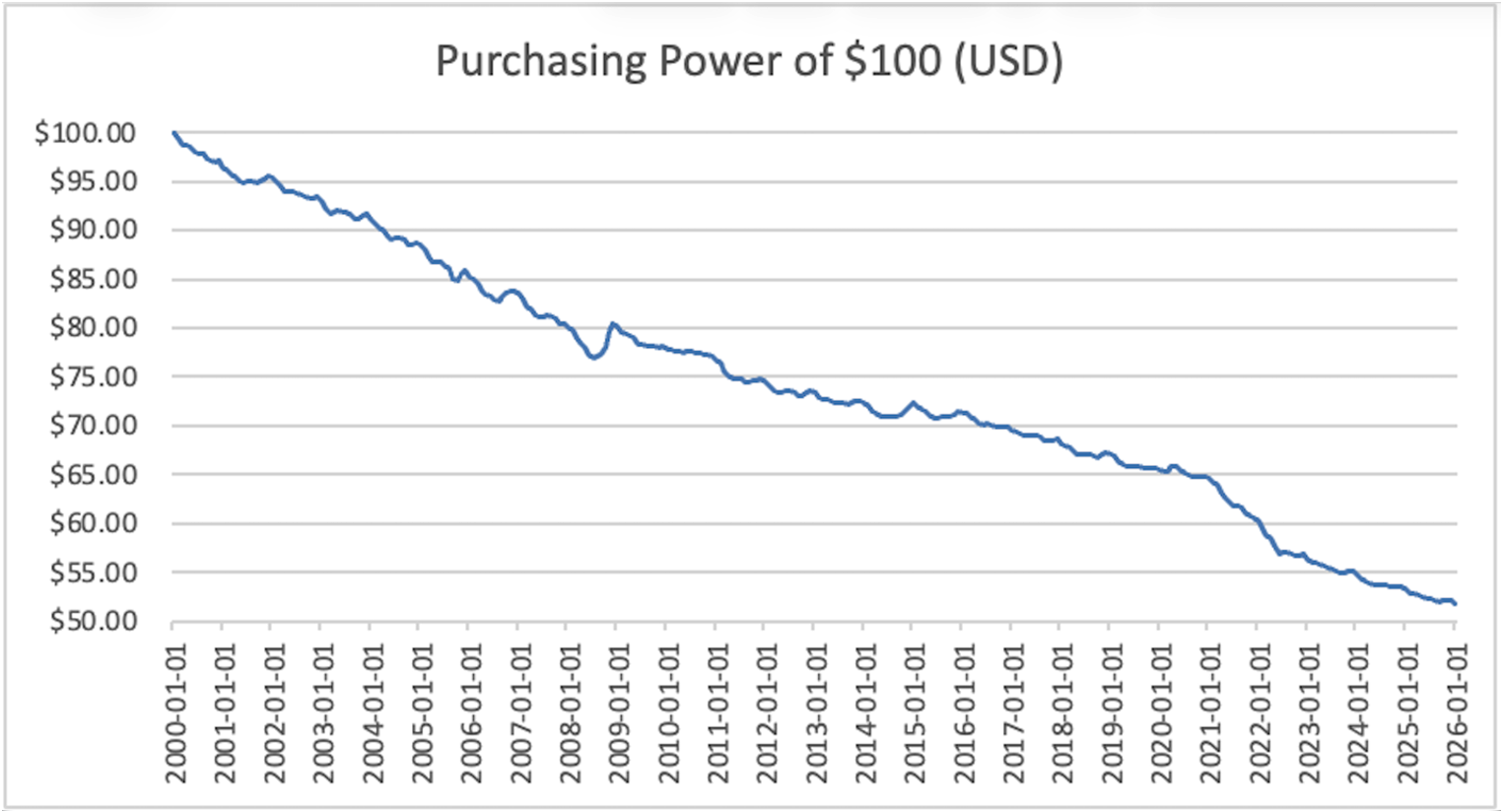
Purchasing Power Source (as of Jan 2026): https://fred.stlouisfed.org/series/CUUR0000SA0R"/>https://fred.stlouisfed.org/series/CUUR0000SA0R
Geopolitical shocks like wars, sanctions, or trade disputes can ripple through the interconnected global economy. Russia’s invasion of Ukraine in 2022 led to large-scale sanctions by the U.S. and European governments, triggering significant volatility in oil markets.2 Renewed conflict in the Middle East — including U.S. and Israeli strikes on Iran — has sharply heightened that volatility, with Brent crude and U.S. oil benchmarks climbing to multi-month highs as traders price in the risk of disrupted supply through the Strait of Hormuz, a chokepoint for roughly 20% of global oil shipments. Global oil benchmarks surged as much as 13% in a single session, and analysts suggest that the threat of ongoing supply disruptions could add a “geopolitical risk premium” of more than $10–$14 per barrel to prices.3
Government policy can also create dislocations. Following the pandemic-era supply chain disruptions in the early 2020s, inflation surged. The Federal Reserve responded by raising interest rates from near 0% to over 5%, pushing bond prices sharply lower and pressuring equity valuations.4
Liquidity risk:
Liquidity risk is a quieter hazard, as defined by the inability to sell assets quickly at a reasonable price during times of stress. When markets are stable, liquidity is often taken for granted. It reemerges during crises.
Harvard University’s endowment during the 2008 financial crisis provides a classic example. After allocating heavily to illiquid alternatives — private equity, private credit, hedge funds, and real estate — Harvard struggled to generate cash when markets fell.5
As asset prices declined and credit markets froze, the university faced the possibility of selling assets at steep discounts, locking in losses. Luckily, Harvard was able to issue bonds to cover their short-term cash needs. Unlike institutions, individuals cannot issue bonds and have limited options to raise emergency cash. They would likely be forced to sell assets at unfavorable prices or take on onerous personal debt. Being forced to sell at depressed prices can permanently impair the ability to meet long-term obligations.
The risk can largely be mitigated by investing in highly liquid public assets, such as broad-based ETFs. Even during the depths of the 2008 crisis, SPY (State Street SPDR S&P 500 ETF Trust) maintained strong daily trading volume, providing ample liquidity to investors.
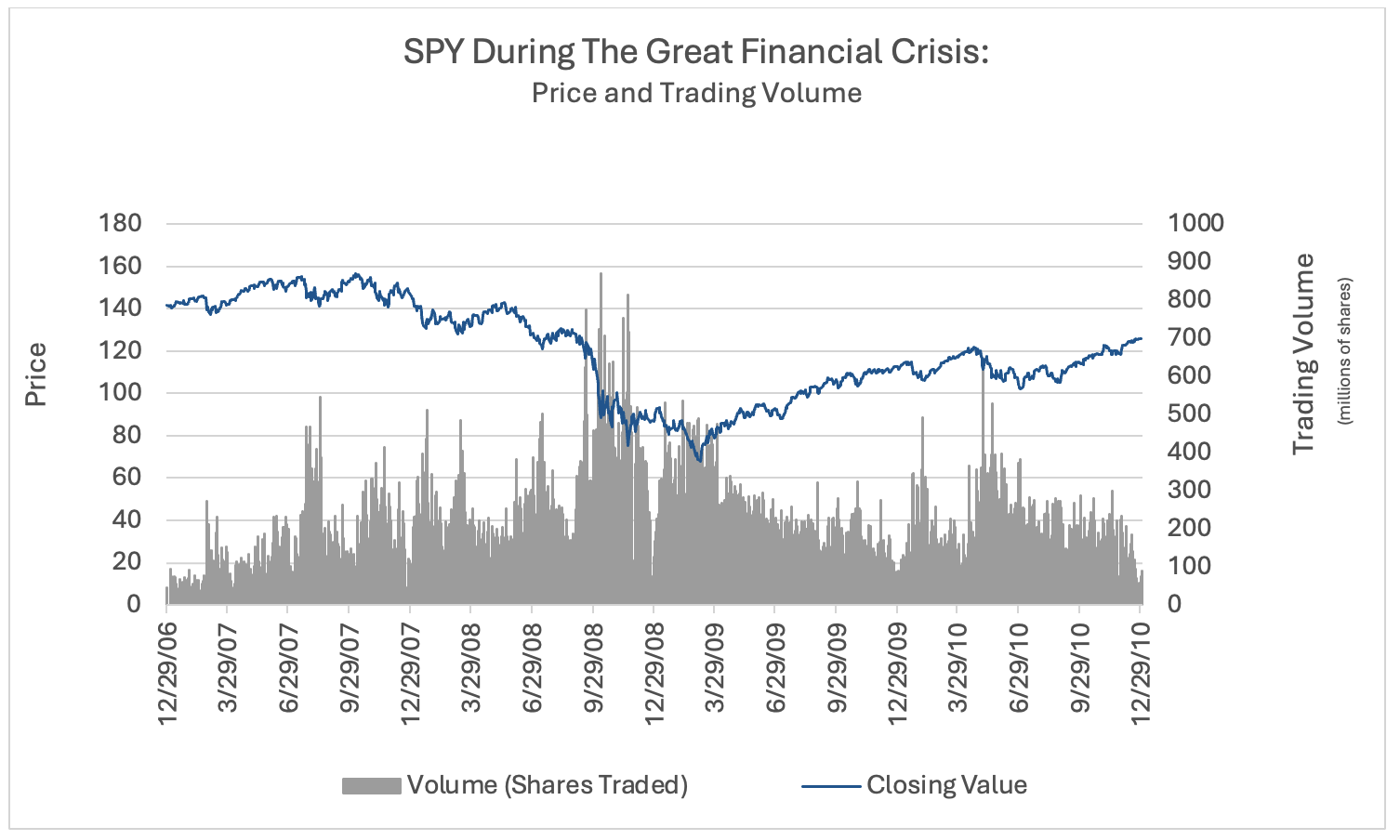
SPY Volume Source (as of Dec 2010): https://finance.yahoo.com/quote/SPY/history/?period1=1167350400&period2=1293753600
*This ETF is displayed for educational purposes only and does not constitute investment advice or a recommendation to invest in any security.
Credit risk:
In fixed income (bond) markets, credit risk is paramount. Credit risk is the potential for loss if a borrower fails to repay a loan or meet contractual obligations (referred to as a default). It applies to all borrowers who cannot create currency to repay their debts.
Investors in U.S. corporate bonds earn a “spread” above comparable U.S. Treasury bonds to compensate for default risk and potential loss severity. During crises, these spreads can widen dramatically, causing bond prices to fall. In early 2020, high-yield bond spreads rose from under 4% to nearly 11%. Even investment-grade bonds were affected, with spreads rising from roughly 1% to over 4%.6
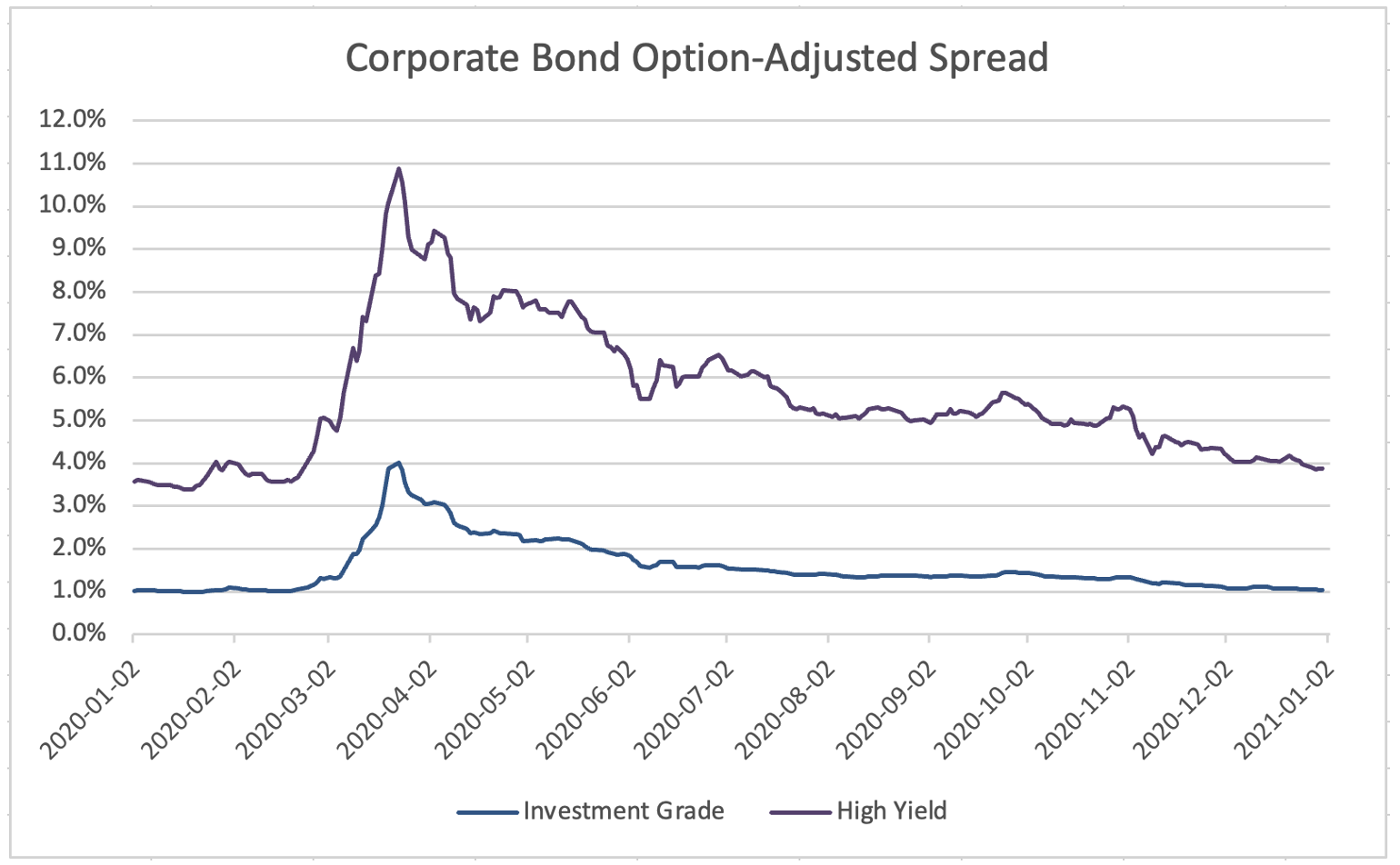
Corporate Spreads Sources (as of Jan 2021): High Yield https://fred.stlouisfed.org/series/BAMLH0A0HYM2 and Investment Grade https://fred.stlouisfed.org/series/BAMLC0A0CM
Although high-quality corporate bonds often have low correlation with equities, that relationship tends to shift during stress.7 In crises, correlations often rise as investors reassess credit risk. The experience of 2022, when both stocks and bonds declined amid surging inflation and rapid Federal Reserve rate hikes, serves as a reminder that diversification benefits can vary depending on the source of the shock.8 By contrast, U.S. Treasuries typically benefit from a “flight to safety,” with yields falling and prices rising, providing ballast to portfolios.
Among the major risk categories, credit risk is often the easiest to reduce or avoid through disciplined portfolio construction.
Distinct from the three external risks mentioned above, one internal risk that is not compensated is concentration risk. This is also referred to as unsystematic or business risk. This arises when an outsized portion of returns depends on a single company or sector. Because this risk can be diversified away at minimal cost, financial theory suggests investors should not expect additional return for bearing it.
Concentration risk is one of the few risks investors can almost entirely eliminate through diversified funds spanning companies, sectors, asset classes, and geographies.
The divergence between traditional risk metrics and the true risk individuals face stems from an objective mismatch. Many common statistics were designed for professional portfolio managers, who often think in quarters rather than decades and focus on price movement instead of client outcomes.9 This has led to an overemphasis on short-term volatility and an underappreciation of long-term drags such as excessive fees and the erosion of purchasing power.
Risk cannot be reduced to a single number, nor can it be perfectly quantified. For individuals, managing risk involves both qualitative measures, like your emotional response to short-term losses, and quantitative measures that can assess your capacity to take on risk.
Risk is not something to be avoided entirely. It is something to understand and manage. Returns are the reward for bearing risk. When risk is thoughtfully taken, diversified, and aligned with long-term goals, short-term discomfort can ultimately lead to long-term success.
Sources:
[1] Markowitz, Harry M. "Portfolio Selection: Efficient Diversification of Investments." (1959). https://books.google.com/books?hl=en&lr=&id=GZDyAAAAQBAJ&oi=fnd&pg=PP2&ots=7cEqUbLAHW&sig=Gs_QxRNl-a5DfWRrbSwnmwEcWgU#v=onepage&q&f=false
[2] International Energy Agency. "Ukraine’s Energy Security." (2025 October 22). https://iea.blob.core.windows.net/assets/5e369891-b922-4f4c-9e02-079e4acc56f8/Ukrainesenergysecurity-Apre-winterassessment.pdf
[3] Goldman Sachs. "How Will the Iran Conflict Impact Oil Prices." (2026 March 3). https://www.goldmansachs.com/insights/articles/how-will-the-iran-conflict-impact-oil-prices
[4] Federal Reserve. "The Federal Reserve’s Responses to the Post-Covid Period of High Inflation." (2024 February 14). https://www.federalreserve.gov/econres/notes/feds-notes/the-federal-reserves-responses-to-the-post-covid-period-of-high-inflation-20240214.html
[5] Harvard Magazine. "Harvard Financial Losses Extend Beyond the Endowment." (2010 January 1). https://www.harvardmagazine.com/2010/01/harvard-2009-financial-losses-grow?_gl=1*1orw802*_ga*MTQzMzk0NjU2NS4xNzcyNDcwMDY5*_ga_NRT2D6GKXJ*czE3NzI0NzAwNjkkbzEkZzEkdDE3NzI0NzAxMjkkajYwJGwwJGgw
[6] Federal Reserve. "The Corporate Bond Market Crises and The Government Response." (2020 October 7). https://www.federalreserve.gov/econres/notes/feds-notes/the-corporate-bond-market-crises-and-the-government-response-20201007.html#:~:text=The%20Covid%2D19%20pandemic%20led,bonds%20came%20to%20a%20halt
[7] Molenaar, Roderick, et al. "Empirical Evidence on the Stock–Bond Correlation." (2024). Financial Analysts Journal, 80(3), 17–36.https://doi.org/10.1080/0015198X.2024.2317333
[8] Morning Star Indexes. "Asset Class Diversification May Not Have Worked in 2022, but its Long-term Value to Investors Remains." (2023 January 19). https://indexes.morningstar.com/insights/perspective/blt9cf6f96b4ec83d66/asset-class-diversification-may-not-have-worked-in-2022-but-its-long-term-value-to-investors-remains
[9] National Bureau of Economic Research. "Portfolios for Long-Term Investors." (2021 February). https://www.nber.org/system/files/working_papers/w28513/revisions/w28513.rev0.pdf

v 2.4.161 | © One Day In July LLC. All Rights Reserved.


