February 04, 2026
Five thousand years ago, ancient Mesopotamians rolled dice to wager and communicate with the divine. Much has changed since then. We live longer, healthier lives thanks to extraordinary technological progress. But one thing hasn’t budged: the human urge to bet on uncertain outcomes.
Today, gambling is more accessible than at any point in history. From your phone or laptop, you can speculate on everything from stock prices to sports scores to political elections without leaving your couch. The result is a full-blown betting boom.
As gambling has gone mainstream, the line between investing and speculating has blurred. On the surface, both involve risking money in pursuit of a return. But the similarities end there.
Investing gives you ownership in assets that can generate economic value over time. Through stocks and bonds, investors either own small stakes in businesses or lend money to governments and companies that pay interest. In a business, investors have a legal claim on future earnings, residual claims on assets, voting rights, and profits. Those earnings may be reinvested by the business or distributed as dividends or share repurchases.
Index investing spreads exposure across many firms or sectors, aiming to capture broad economic growth rather than the fate of a single company.
Gambling, by contrast, is largely a transfer of wealth from losers to winners, a cost paid in exchange for excitement. Most bets are binary: you’re either right or wrong. Investing, on the other hand, unfolds across a range of outcomes, better described as a probability tree than a coin flip.
History reflects this divide. Since 1990, the broad U.S. stock market has returned about 10% annually on average, as measured by the S&P 500. Meanwhile, a study of more than 700,000 gamblers found that 96% lost money over time.1
One of the clearest examples of this grey area is the surge in zero-days-to-expiration (0DTE) options. Options are contracts that allow investors to buy or sell an underlying security at a specific price by a certain date. Traditionally, these were tools used by professionals for hedging risk.
0DTE options change the equation. They allow traders to place highly leveraged bets on where an asset will land by the end of a single trading day. With a relatively small amount of money, speculators can make outsized wagers on short-term market moves.
Fueled by social media, aggressive marketing campaigns from certain brokers, and the expansion of daily option expirations, retail investors have piled in. Today, 0DTE options account for more than 50% of all SPX (the S&P 500 index) option volume, with retail traders responsible for roughly half of that activity.2 In 2025, average daily SPX option volume reached 3.9 million contracts, representing over $1 trillion in notional value.3
These instruments aren’t limited to major indexes. They are now widely available on individual stocks and exchange traded funds (ETFs), offering endless opportunities for high-risk speculation.
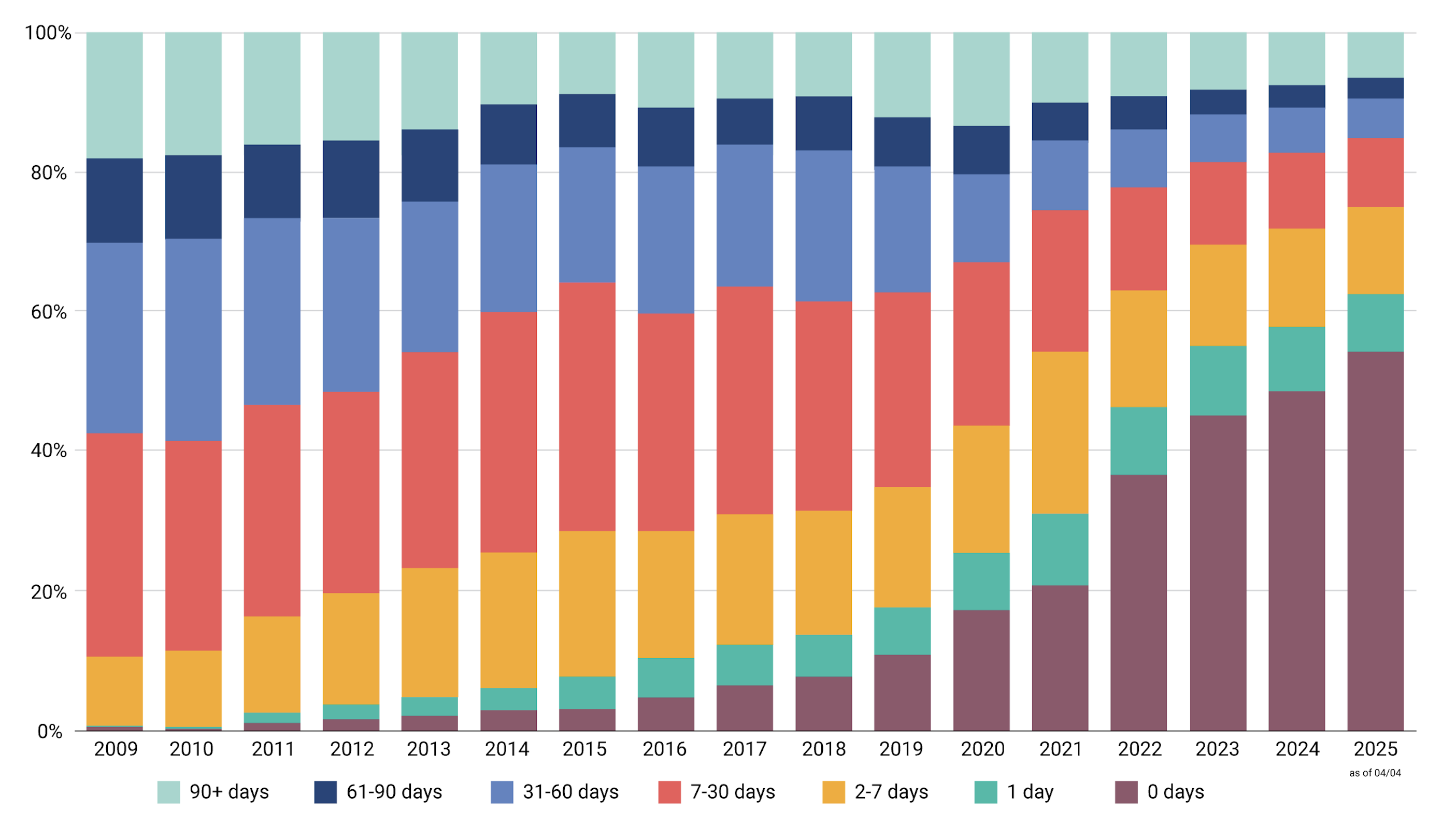
Chart Source: Cboe.com
Speculation has also increased alongside greater use of leverage. Margin debt allows investors to borrow money to amplify their bets. For example, an investor with $100 could control $200 of securities using 2x leverage. Across U.S. margin accounts, leverage has risen sharply over the past decade, exceeding 3x for the first time in late 2025. This also works in reverse. If the investment declines by 10%, the leveraged investor would experience a 20% loss on their original capital, excluding interest and fees.
Another fast-growing path to leverage comes from leveraged ETFs, which aim to deliver two to five times the daily return of an index or individual stock. By October of last year, roughly 200 new leveraged equity ETFs had launched, bringing the total to more than 700.4 Because of daily rebalancing and volatility, returns over multiple days can differ significantly from the underlying index and may even underperform.5
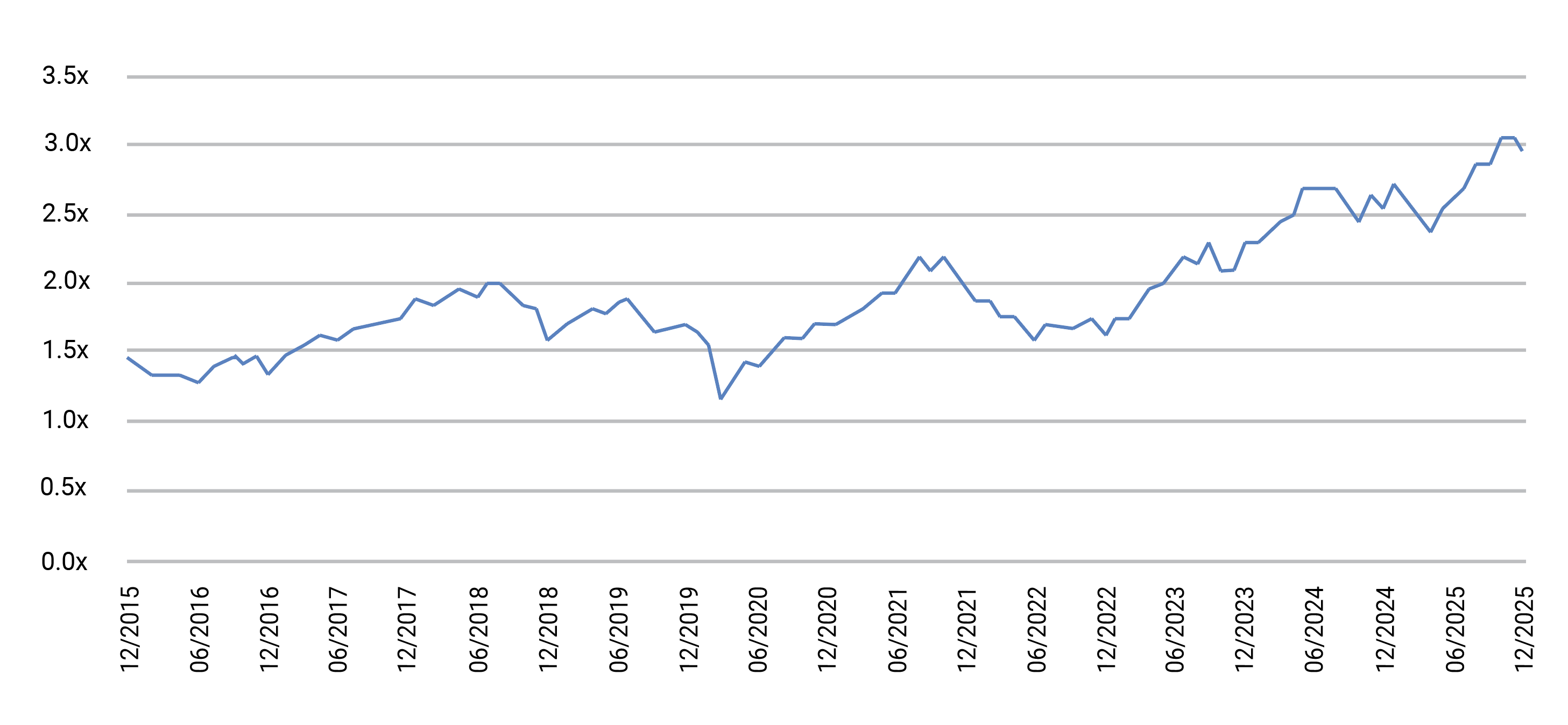
Chart Source: FINRA.org
In 2018, the U.S. Supreme Court struck down a federal ban on state-sponsored sports betting. What was once largely underground moved into the mainstream almost overnight. States rushed to legalize the activity, and betting volumes exploded.
Legal sports wagers totaled $6.6 billion in 2018.6 By 2024, that figure exceeded $148 billion, with early estimates putting 2025 volume between $160 and $170 billion.7
Like roulette, sportsbooks operate with a built-in edge. In roulette, the two green slots give the house a 5.26% advantage over time. In sports betting, the edge comes from the spread between favorites and underdogs. If the favorite on one side has odds of -200 (meaning you need to bet $200 to win $100) and the underdog’s odds on the other are +150 (meaning you need to bet $100 to win $150), it creates a 6.25% house edge across a large number of bets.What’s more troubling is how bettors perceive these platforms. A 2024 study found that 31% of sport bettors viewed gambling as an investment, and 65% said they were betting to make extra money.8 This belief runs directly counter to how sportsbooks operate. DraftKings CEO Jason Robins has been blunt on the topic: “This is an entertainment activity. People who are doing this for profit are not the players we want.”9
In practice, the incentives run the other way. Platforms actively manage risk by limiting or restricting winning players, while allowing losing players to continue betting — an approach that closely mirrors casino economics.
Prediction markets add another twist. These platforms allow users to wager on real-world outcomes like elections, court rulings, or award shows. Unlike sportsbooks, prediction markets are regulated as derivatives exchanges by the Commodity Futures Trading Commission (CFTC), not state gaming authorities. This distinction has allowed platforms like Kalshi and Polymarket to operate nationwide.
Unlike sportsbooks, prediction markets operate as peer-to-peer exchanges rather than setting odds against bettors. Estimates of their size vary, but most point to rapid growth. One research report suggested $28 billion in prediction-market trading volume in 2025, more than four times the prior year.10
Supporters argue these markets provide real-time insights and useful hedging tools. Critics warn of weak regulation, susceptibility to manipulation, and the inherently speculative nature of many contracts.
The desire to wager is deeply human. We crave excitement, instant gratification, and validation of being right. But today’s tools of instant access, extreme leverage, and constant stimulation have supercharged those impulses. Whether in markets, sports, or politics, speculation is booming. And in an environment where bets can be placed in seconds and leverage is just a tap away, discipline matters more than ever.
One simple rule still holds: If it feels thrilling, it’s probably not investing.
Sources:
[1] University of California San Diego Rady School of Management. (June 18, 2024). "Online Gambling Policy Effects on Tax Revenue and Irresponsible Gambling." https://drive.google.com/file/d/1o5epbZYxEtdJ2gmOH1vHdxihrmhNBe__/view
[2] Cboe Macro Volatility Digest. (June 2, 2025). "SPX 0DTE Options Jump to 61% Share on Retail Resurgence." https://go.cboe.com/l/77532/2025-06-02/fmtxvz/77532/1748867849rr7COnLC/Macro_Volatility_Digest_2025Jun2.pdf
[3] Cboe News. (January 6, 2026). "Cboe Global Markets Reports Trading Volume for December and Full Year 2025." https://ir.cboe.com/news/news-details/2026/Cboe-Global-Markets-Reports-Trading-Volume-for-December-and-Full-Year-2025/default.aspx
[4] The Wall Street Journal. (October 23, 2025). "Popular Leveraged Funds Shock Investors With Huge Losses." https://www.wsj.com/finance/investing/popular-leveraged-funds-shock-investors-with-huge-losses
[5] One Day In July. (January 2025). "Quarterly Booklet Winter 2025, Issue XXX." https://media.onedayinjuly.com/media/pdf/2025_Winter_Quarterly_Booklet_DIGITAL_V.pdf
[6] Sportsbook Review. (January 30, 2026). "U.S. Sports Betting Revenue and Handle: Tracking Betting Market Data 2026." https://www.sportsbookreview.com/news/us-betting-revenue-tracker/
[7] TrafficGuard. (December 5, 2025). "The State of the U.S. Sports Betting Market in 2026." https://www.trafficguard.ai/blog/the-state-of-us-sports-betting
[8] NerdWallet. (January 28, 2025). "2025 Sports Betting and Gambling Survey." https://www.nerdwallet.com/investing/studies/2025-sports-betting-and-gambling-survey
[9] Rolling Stone. (November 17, 2024). "Is the $11 Billion Sportsbook Bubble About to Burst." https://www.rollingstone.com/culture/culture-sports/sports-betting-law-draftkings-fanduel-1235158334/
[10] The Block. (December 2025). "2026 Digital Assets Outlook." https://www.tbstat.com/wp/uploads/2025/12/20251213_EOY_Report-2.pdf

v 2.4.161 | © One Day In July LLC. All Rights Reserved.


